The fruits of Extreme Weather

  • Comments 5

For the past few months, the staff at Astronomy has been working on a special publication titled Extreme Weather. On newsstands now, the magazine covers the science of weather and its effects. Extreme Weather features articles on violent weather, weather science, weather imaging, and more for both casual observers and serious enthusiasts.
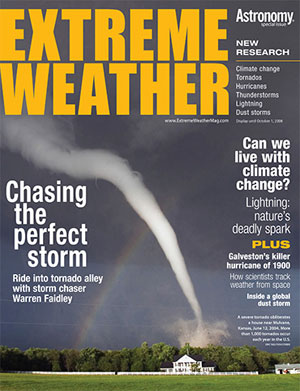
We have received some excellent feedback from weather experts around the country who have previewed the magazine.

Jeff Masters from Weather Underground, Inc., one of the most popular weather web sites in the world, reviewed Extreme Weather in his blog and writes that the magazine includes “awesome shots of tornadoes, lightning, floods, supercells, hail, hurricane winds, and waterspouts. The first article of the magazine features the equally fantastic photos of storm chaser Warren Faidley, who also happens to be the best writer among professional storm chasers, in my opinion.”

Masters is referring to the article “Chasing the perfect storm,” which follows Faidley on his quest for the most dangerous photo opportunity. Read all of Masters’ blog here.

Mike Buresh, meteorologist for CBS 47 and Fox 30 in Jacksonville, Florida, says: “The old saying 'a picture is worth a thousand words' is put to good use in Extreme Weather. It is a publication that will interest a wide range of 'weather-holics' ranging from the novice to the professional.” Buresh also blogged about the new publication. Read it here.

Lee Tolliver writes: "Being the Outdoor Editor at The Virginian-Pilot, I always have found it useful to know as much about the weather as possible. I took two classes in college and was really bitten by the weather bug. Our company owns the Weather Channel, so getting people to teach me has been easy. I do everything I can to learn more. So I was ecstatic when I got my copy of Extreme Weather. The photos and information in it are incredible. I really find it hard to put the magazine down."

Find more expert comments and order your copy of Extreme Weather here.

Want to leave a comment on this blog post?
Login or register for an account to join our online community today!
  • A question on the cover reads: "Can we live with climate change?". Between day and night the temperature changes 10°C or 15°C. Between summer and winter it changes 15° to 20°C. Some say the world can't withstand a 5°C hike in a century. But the world withstands much larger differences in much shorter timespans. If people and nature resist daily and yearly  change, why couldn't they resist a 100-fold slower modification?

  • You may be reading this a little too literally.

    Of course people and nature can live with longer-scale temperature changes. The point, however, is that they'll be doing so on a different world: growing seasons, precipitation patterns, pest and disease distribution, among other things, will be different. Here in Wisconsin, for example, gardeners will tell you they're able to grow many plant species that couldn't tolerate this climate a decade or two ago.

  • What's wrong with difference?

  • It disrupts long-established, stable patterns we've come to rely on and replaces them with less stable, less understood patterns. If your house is getting a "100-year flood" every decade, for example, you might conclude a changed climate  pattern is a net negative for you. Read the article.  

  • I have not read this particular article but I saw and heard a lot of coverage about future weather. Almost all of it is alarmist. If future climate is indeed warmer, will it necessarily be less stable? Would this instability necessarily hurt? We - and nature - easily withstand daily and yearly differences; would a longer-term instability bother us much? If Earth's climate changes noticeably, some people will experience a improvement, some will get worse off, and some will have different but neither better nor worse life.

    However the worst prospects are mentioned more often than good and neutral ones. Russia welcomes a melting of its tundra: it would make an immense tract of land more hospitable to animal, vegetal and human life. Northern Europe is livable because the polar hood no longer covers it. The ice desert's recession opened the land to plants, wildlife and human hunters and farmers. It was a disruption of weather but no one complaints about it.

    Many worry that melting polar hoods would rise oceans and shrink lands. But if icy land warms up, more ground becomes hospitable, thus offsetting the loss due to rising oceans. Not all changes are bad but most of the press singles out the alarmist modifications. Why focus on the negative? There were many catastrophic predictions in previous decades; how may of them materialized? Why should today's alarmism be more credible than past alarmism?

The fruits of Extreme Weather